

Show me / tell me questions
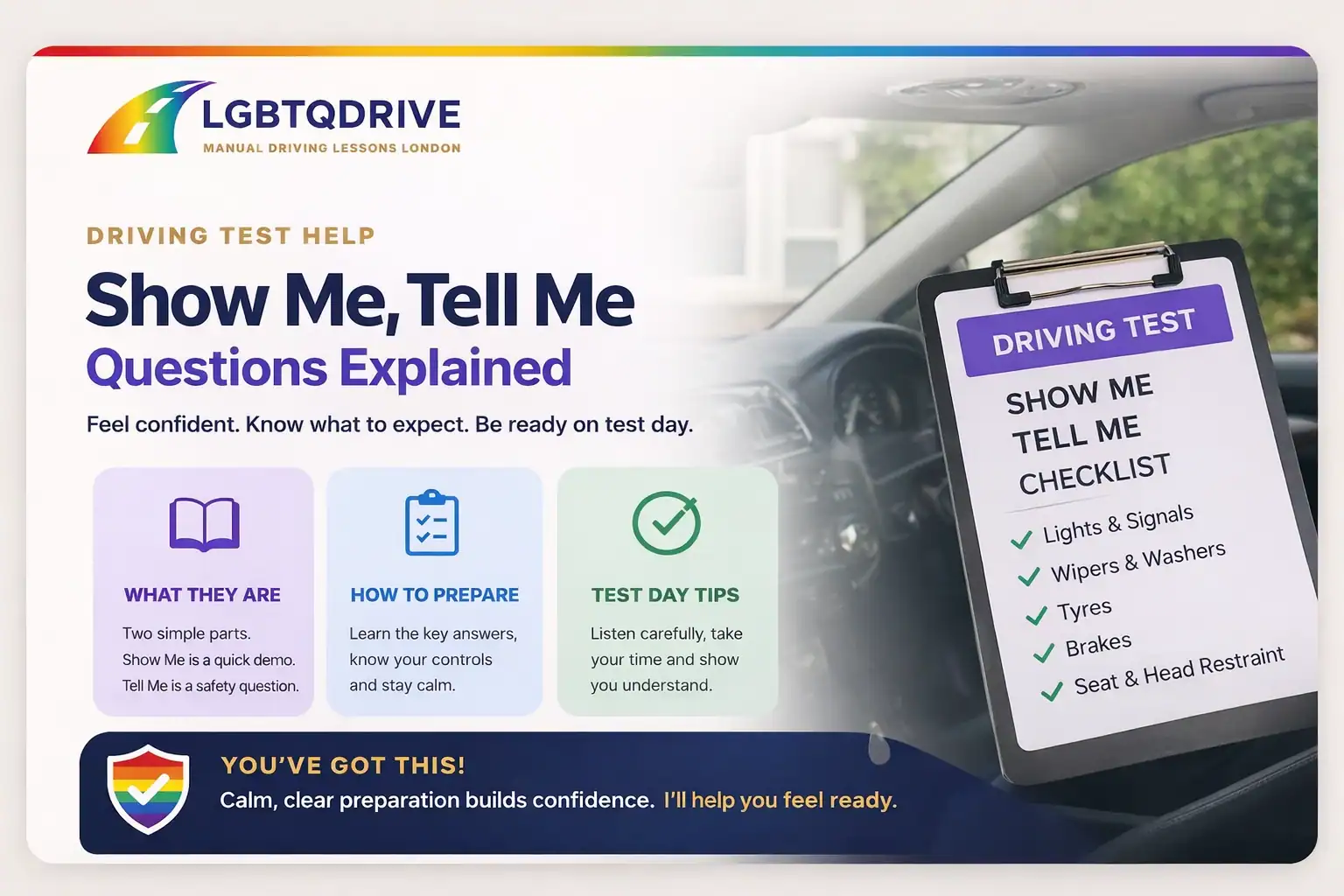
Show tell questions London learners need for the practical driving test are simple safety checks, but they can still feel stressful if you have not gone through them properly beforehand. At the start of the practical test, the examiner asks one “tell me” question before you drive and one “show me” question while you are driving. These questions are there to check that you understand basic vehicle safety and control.
The good news is that you can get one of these questions wrong and still pass your test. These show tell questions London learners worry about are not designed to catch you out, and with a calm explanation and a bit of practice they become much easier to remember. This page brings together the full DVSA-style list in one place so you can read through them before lessons or before test day.
If you are a nervous learner, show tell questions London learners often worry about can feel bigger in your head than they really are. The best approach is to treat each question as a short, practical routine. Once you understand the logic behind the answer, the questions start to feel much more manageable.
How show tell questions London learners get asked on test day
The “tell me” question is asked before you start driving. The “show me” question is asked during the test while you are on the move, so the examiner will say “when it’s safe” before asking you to do something simple such as operate the windscreen washers or dipped headlights. This means you should always keep driving safely first and only carry out the instruction when the road situation allows it.
You can read more about the practical test itself on the driving test day page, and you can also read the official DVSA practical driving test guidance.
Show me questions (asked while driving)
When it’s safe, show me how you would wash and clean the rear windscreen
When it’s safe, show me how you would wash and clean the front windscreen
When it’s safe, show me how you would switch on dipped headlights
When it’s safe, show me how you would set the rear demister
When it’s safe, show me how you would use the horn
When it’s safe, show me how you would demist the front windscreen
When it’s safe, show me how you’d open and close the side window
Tell me questions (asked before driving)
Tell me how you’d check that the brakes are working before starting a journey
Tell me where you’d find the information for the recommended tyre pressures for this car. Also tell me how you should check the tyre pressures
Tell me how to adjust your head restraint correctly, so it provides the best protection if you crash
Tell me how you’d check that the tyres have enough tread depth and that their general condition is safe to use on the road
Tell me how you’d check that the headlights and tail-lights are working. (No need to get out of the car)
Tell me how you’d know if there was a problem with your anti-lock braking system
Tell me how you’d check the direction indicators are working. (No need to get out of the car)
Tell me how you’d check the brake lights are working on this car
Tell me how you’d check the power assisted steering’s working before starting a journey
Tell me how you’d switch on the rear fog light(s). Also explain when you’d use it/them. (No need to get out of the car)
Tell me how you switch your headlight from dipped to main beam. Also explain how you’d know the main beam is on
Open the bonnet and tell me how you’d check that the engine has enough oil. Please do not touch the engine
Open the bonnet and tell me how you’d check that the engine has enough engine coolant. Please do not touch the engine
Open the bonnet and tell me how you’d check that you have a safe level of hydraulic brake fluid. Please do not touch the engine
How to remember the show tell questions London learners get asked more easily
The easiest way to remember the show tell questions London learners get asked is to group them by topic. Some are about windows and wipers, some are about lights, and some are basic under-bonnet safety checks. Once you stop seeing them as a long random list and start seeing them as a few simple groups, they become much easier to remember.
You do not need to sound mechanical or over-rehearsed. A calm, simple answer is enough. In lessons, these show tell questions London learners practise usually become second nature because you hear them more than once and connect them to the actual car controls. That is why practise matters more than memorising word for word.
- Practise the controls in the actual lesson car
- Group questions by lights, windows, tyres and under-bonnet checks
- Keep answers short and practical
- Remember that safety comes first during “show me” questions
- Do not panic if you are not word-perfect
Ready for test day
These questions become much easier with practice. If you want calm support with show tell questions London learners often worry about, I will cover them as part of your normal lessons so they feel familiar well before the test.